
When one talks of cloud hosting, what comes to his mind? To most, it is convenient, scalable and economical. To some it is skepticism, questions such as, Are my data really safe when it is not on a server that I can touch? That has been the root cause of endless cloud security mythology.
The fact is that cloud hosting can be as safe and even safer than the traditional systems that are on premises. The trick is knowing what is myth or what is reality and what the businesses can do to ensure their data is secured. Let’s break it down.
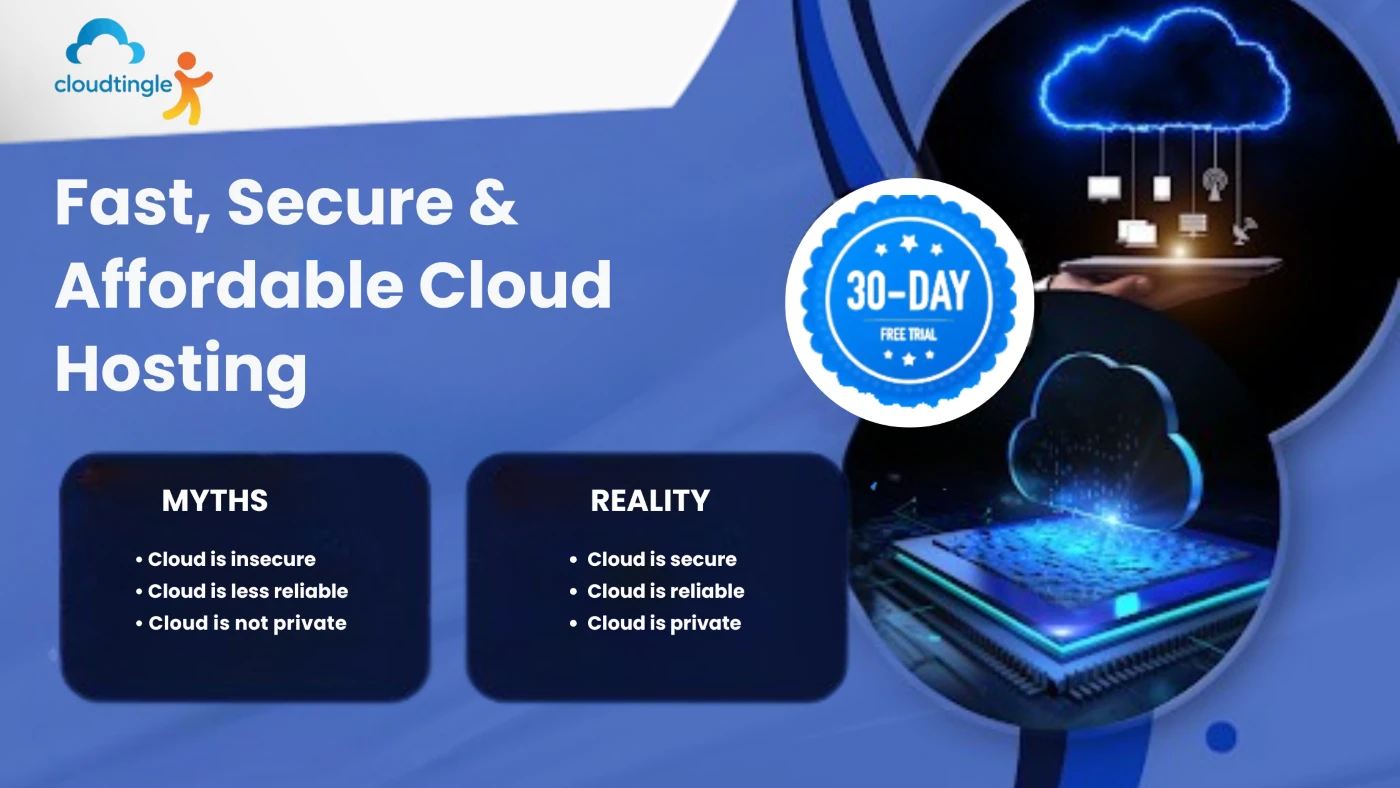
Cloud Security Myths That Will Not Die.
The myth about clouds being insecure is one of the largest ones. Hackers are pictured by people lurking around the data centers of enormous size in search of an entry point. The reality? The giant Cloud vendors spend billions of money on advanced security, which most companies would never have been able to afford by themselves.
The other myth is that when you send the data to the cloud, you lose control. As a matter of fact, cloud models are constructed on shared responsibility: the providers ensure the infrastructure, but the customers get to take care of such aspects as access control, password hygiene, and right configurations.
There is the myth of compliance. There is an opinion that such regulations as GDPR or HIPAA cannot be achieved in the cloud. Nonetheless, large providers tend to be already satisfying those criteria. The only task is to ensure that your workloads are set in a way that they are compliant.
And lastly, individuals believe that there are more breaches in the cloud. As it turns out, the vast majority of breaches are caused by human error either by compromised passwords or unconfigured storage buckets or by clicking the incorrect link by the employee. It is not the cloud that is normally the problem.
Cloud Computing:
Differences exist among clouds.Here’s the quick landscape:
- Public Cloud: Think Hostzop. Inexpensive, scalable and not particular to a single customer.
- Private Cloud: Belongs to a single organization. More control, which is common in such industries as banking or healthcare.
- Hybrid Cloud: This is a combination of the two-sensitive workloads remaining private and less vital workloads are scaled on the public cloud.
- Multi-Cloud: To provide risk-diversification and eliminate lock-in, use the services of several providers.
And Service Layers There Are:
- With IaaS (Infrastructure as a Service): you have power over applications and data, whereas the provider takes care of the infrastructure.
- In PaaS (Platform as a Service): you are just doing the apps, while the vendors are doing more for you.
- SaaS (Software as a Service): The service provider will practically do it all.
Both models change the burden of responsibility. Who knows what is half the battle.
Security And Compliance Risks Management.
Then, what is the actual method the businesses use to ensure data safety in the cloud? There is no compromise on encryption. Data must be encrypted during transmission and when stored.
- Identity and Access Management (IAM): Access should be limited according to the newly defined roles, multi-factor authentication should be required, and user access should be reviewed regularly.
- Monitoring: Ongoing auditing and security tools can be utilized to discover unusual activity which could become problematic before it really is a problem.
- Checks on compliance: Adhere to industry regulation on the cloud. The tools are provided by the providers; you have to make use of them.
- Recovery and backup: Disaster recovery systems and failover systems are not part of a security plan.
Major Things Before Moving To The Cloud.
One should not put all workloads in the cloud and not all providers are suitable to all businesses. The following are some things to consider:
- Data location matters: When your provider uses data outside of the country, you may be facing overseas laws.
- Provider certifications: Find compliance certification such as ISO 27001 or SOC 2.
- Third-party integrations: APIs and plug-ins are usually neglected yet they can make entry points to attackers.
- People factor: Employees are still the weakest point. Firewalls are not more significant than security awareness training.
What Comes In The Cloud And How Businesses Use It.
The cloud has been known to support some workloads:
End-infinite scale data storage and backups. Efficiency SA tools such as Microsoft 365 or Slack that maintain communication among teams in a secure manner.
Application hosting to make apps available and scalable at all times. Disaster recovery as a service (DRaaS) to continue functioning in the event of a disastrous incident.
Big computing computing requirements that are better achieved by the cloud. With that said, ultra-sensitive data can still be stored in a hybrid or a private setting based on the regulations and risk appetite.
So, Is Cloud Hosting Secure?
The fact is that in this case, Cloud Hosting may be highly secure but it is not a magic bullet. The provider is the one who locks down the infrastructure but it is you -the customer- who needs to lock down your access points, data policies and compliance.
Imagine it as the renting of a high-security apartment. Cameras, guards and alarms are placed in the building- yet- leave your door unlocked, then it is your fault with the landlord.
The cloud is not the security threat that many people have feared. It’s a powerful, flexible tool. And in cases where businesses take their responsibilities seriously and adopt the best practices, the cloud may be very safe compared to most traditional systems.
Conclusion: Cloud security does not concern the issue of the safety of the cloud itself. It’s about how well you use it.


One thought on “Is Cloud Hosting Secure? Myths Vs Reality.”