

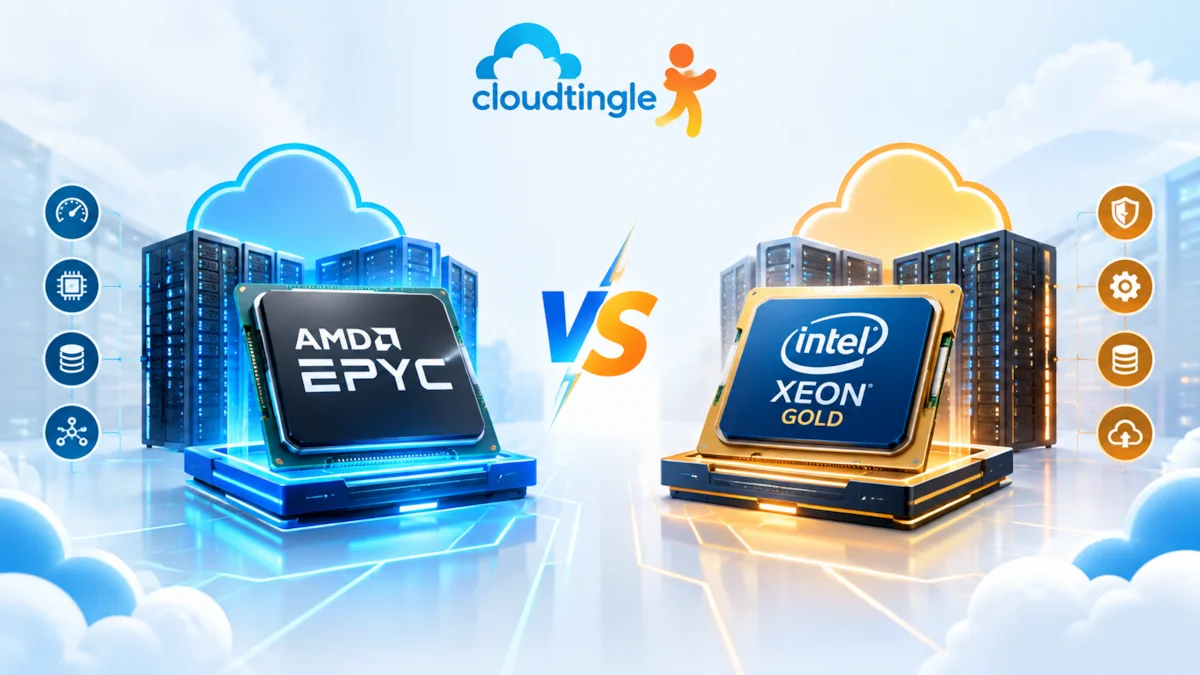
Selecting a cloud server processor is more critical than taking into account only core counts or advertised clock speeds. Processor architecture can impact responsiveness, scalability, virtualization efficiency and overall infrastructure economics for businesses that operate websites, applications, databases, APIs, and enterprise workloads in the India region. Cloud processors often come in two processor families which are taken into account: AMD EPYC and Intel Xeon Gold.
Which one is the better option, though? The answer is not based on brand loyalty but is determined by the workload characteristics and requirements, software compatibility, and budget.
Understanding AMD EPYC Cloud Servers
EPYC Processors are specially crafted for Data Center/Enterprise workloads. High core density, high memory capacity and high parallel processing capacity are the features they pay attention to in their architecture. EPYC is especially appealing for cloud environments, where several virtual machines or containers can be running concurrently.
Cloud servers based on the AMD EPYC processor can be suitable for virtualization, web applications, containerized deployments, analytics, development environments and databases. EPYC’s large core and thread count can be an advantage when applications can use it to distribute tasks between multiple CPU core and thread configurations.
Another factor is memory bandwidth. Data requirements have grown with the modern applications that are being used, and when the CPU is spending too much time waiting for data, this can be a problem. EPYC platforms have been designed to deliver significant memory throughput, which is an attractive feature for memory-intensive workloads.
What Makes Intel Gold Cloud Servers Different?
An Intel Gold Cloud Server is usually a cloud infrastructure system that is based on Intel Xeon Gold processors. The Xeon Gold family has long been a staple in enterprise computing, where software ecosystem support, virtualization, security technologies and stability are all significant factors.
Intel Xeon Gold processors are fantastic for business applications, enterprise databases, virtualization platforms, and workloads tuned to Intel’s instruction-set. Intel-specific acceleration technologies and mature optimization libraries could also be of value for certain applications.
“AMD versus Intel” is not the distinction, therefore. However, there could be quite a big gap between the specifications of different generations and types of processors. One type of the EPYC chip is able to outperform an older Xeon Gold processor, while a particular version of the Xeon Gold processor may be more efficient for a certain type of tasks.
AMD EPYC Vs Intel Gold: Performance Considerations
In the context of workloads that demand a great number of cores and threads, AMD EPYC can offer a compelling value proposition. There are plenty of tasks that could benefit from a lot of processing resources, including rendering, virtualization, large scale compilation, container workloads and concurrent application processing.
Intel Xeon Gold, however, is still a good value for workloads that require application optimization, single-thread responsiveness, or Intel-specific technologies. There are a number of enterprise software ecosystems that have been written and optimised against Intel architectures.
Still, besides single-thread performance, we also need to consider the factors influencing the performance of the cloud server such as the amount of RAM, the storage used, virtualization overhead, network, OS setup, and workload design.
Memory And Virtualization
Cloud computing is a concept of sharing and isolation of resources. Memory architecture is very critical for a physical host that can support multiple VMs, containers, or workloads.
Combined with the high number of cores on each processor and the high bandwidth of the memory, AMD EPYC systems are a favorite for virtualization-heavy deployments. It might be a welcome extra parallel processing power to businesses that are operating multiple applications at the same time.
Intel Xeon Gold also offers good virtualization and is a popular product in enterprise markets. If an organization has a solid infrastructure that focuses on Intel, migration and compatibility concerns may make Xeon Gold feasible.
What About Cloud Hosting Price?
Processor speed is just a part of the hosting jigsaw. The cloud hosting price may fluctuate, depending on CPU generation, RAM, NVMe or SSD storage, bandwidth, IPv4 allocation, backups, virtualization technology, support and data-center location.
More cores on a server doesn’t necessarily translate to a better price. When one would have 16 cores but limited RAM and slower storage, another would have fewer cores, faster NVMe storage, and more memory, what would you choose? The second configuration may provide a better experience for a DB-driven application.
Cost per performance is thus more meaningful than headline pricing.
Choosing Cloud Hosting India For Different Workloads
The first thing we need to do during the evaluation of the cloud hosting India is to choose the workload that would be processed on our server.
In case the site uses many cores and needs much RAM, it will be great for high traffic websites, application server, API platform, or container clusters. The AMD EPYC processor would be a good choice for these workloads, which are capable of parallel computing and have enough resources.
At the same time, enterprise applications with specific optimizations by Intel, legacy applications, and programs validated on Xeon processors might benefit from Intel Gold. Even if something is theoretically better than a benchmark, it may not be in terms of compatibility.
In both development and testing environments, either architecture can be effective. In such cases, flexible scaling of resources and an intelligent price is more important than a fast processor.
Not To Be Confused About Affordable Solutions
It is natural to opt for the cheapest cloud hosting option; however, it may become the reason for all future issues. The cheap server may turn out to be a bottle-neck due to the small amount of RAM, bandwidth restrictions, poor performance of storage, etc.
The advisable way to do this is to measure the resources needed for the work load, and then compare full configurations. Take into account CPU generation, cores, RAM, storage speed, network bandwidth, backup support, security, uptime guarantees, and technical assistance.
So, not only look to reduce the invoice, but maximize value.
AMD EPYC Or Intel Gold: Which Should You Choose?
No general winner.
If your workload is heavily parallel, virtualization-based or container-based, or is well suited to many CPU cores with significant memory bandwidth, then you need AMD EPYC.
When your applications rely on specific Intel optimizations, applications have known enterprise compatibility requirements, or other technical requirements are specific to the Xeon ecosystem, choose Intel Xeon Gold.
The processor is most of the time not the only specification that concerns the processor so, for most enterprises, it should be chosen alongside the rest of the infrastructure configuration. There are many variables that can affect the actual user experience, such as storage, RAM, networking, virtualization technology, data-center location and support.
Final Thoughts
AMD EPYC and Intel Gold are capable of delivering powerful bases for next generation cloud infrastructure. EPYC may perform better in environments where high compute density and parallel workloads are prominent, whereas Xeon Gold is a good option for enterprise use cases and workloads optimized for Intel.
The greatest smart choice for businesses in India is ultimately workload-driven. Consider the full server design, compare the applications if applicable, review scalability and consider the total cost of the server, rather than just core count or the lowest advertised price.