The relevance of scalable, high-performing and dependable digital infrastructure to current businesses increases rapidly. Whether data is processed in the cloud, on a SaaS application, the Internet of Things or real-time analytics, the data’s location can significantly affect the performance of the application. There are two methods that are often taken into account: edge computing and Traditional Cloud Hosting.
While both models offer infrastructure capabilities, they address different issues. Knowing about their structure, capabilities, expenses, and usability can assist businesses in deciding which setting is ideal for their technical needs and expansion objectives.
What Is Edge Computing?
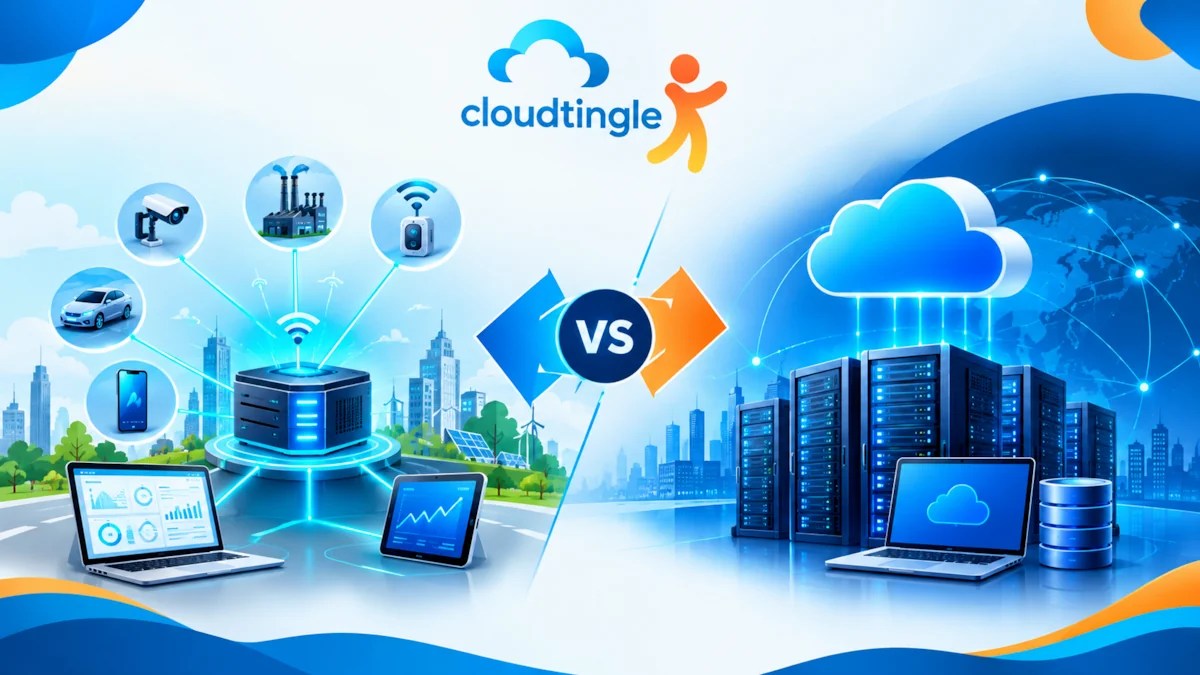
Edge computing is an infrastructure solution where data is processed closer to the people, devices or systems that create the data. Some of the workloads may be done on strategically chosen edge sites, not all of the workloads have to be performed in a central cloud site.
In latency-sensitive applications like industrial surveillance, connectivity, video processing, real-time analytics and gaming even a tiny bit of lag will play an important role.
Edge computing is also capable of minimizing the amount of data sent to a centralized environment. Devices can process information locally and only send relevant information, setting up this to be a more efficient data pipeline.
What Is Traditional Cloud Hosting?
Traditional Cloud Hosting typically involves serving computing resources from a centralized data center or region, and using virtualized infrastructure. Businesses can provision virtual machines, storage, databases, networking resources and more based on the amount of workload.
The elastic nature of cloud hosting has made it popular. Resources can often be increased or decreased without purchasing and maintaining physical servers. This is a great advantage for sites and applications with varying usage patterns.
Some other aspects to keep in mind while selecting cloud hosting providers in India include the following: server location, connectivity, availability of resources, support, security and compliance aspects. When serving a largely Indian audience, geographic location can be important.
Edge Computing Vs Cloud Hosting: Key Differences
The first thing that distinguishes cloud computing from edge computing is where exactly the computing is done.
Typically, applications interact with centralized infrastructure with cloud hosting. Edge computing involves some processing being brought closer to the end user or data source.
1. Latency
For applications that require fast data transfer, Edge infrastructure can provide lower latency. If the information passes through a processing node nearby, the distance to which the information travels can be reduced.
Nevertheless, cloud hosting remains a viable option for achieving high performance, especially if the applications are placed in a data center that is geographically suitable and optimized properly.
2. Scalability
The whole notion of cloud environments is based on the elastic allocation of resources. As needs evolve, businesses can scale up CPU, memory, storage, and more.
Edge deployments can also scale, at the same time, if it is across many distributed locations, it may add more architecture complexity.
3. Infrastructure Management
With cloud hosting, many of the infrastructure management aspects are usually consolidated. Providers manage underlying hardware, virtualization, networking and data centre operations.
Edge computing can need to be managed at different sites and devices. Monitoring, software deployment, security policies and maintenance are thus distributed.
4. Data Processing
When many different data elements are continually created and only a subset of data elements require delivery to a centralized cloud, edge computing is especially valuable.
An industrial sensor network may perform local analysis and alert or report summarized data to the central platform instead of reporting all events.
Understanding Cost Considerations
Rental of the server is not the only cost. Use of resources, bandwidth, storage, administration, security, backups, redundancy and operational overhead should be taken into consideration by businesses.
It’s vital to look at the full pricing model instead of just the initial monthly amount when comparing cloud hosting cost. A low-cost solution can have restrictions on bandwidth, storage, CPU, backups, scaling etc.
Cheap cloud hosting can offer a cost-effective solution for startups and smaller websites, allowing them to move into scalable infrastructure at an affordable cost. But the lowest cost may not be the most cost-effective in the long run. Indirect costs can be caused by performance limitations, migration needs or downtime, as well as support restrictions.
Because infrastructure is spread out, expenses may be added with the introduction of edge computing. Multiple edge nodes, specialized networking, monitoring systems, and other operational processes may be required by businesses.
When Edge Computing Makes Sense
Edge computing may be applicable in situations requiring an application to:
- Extremely low latency
- Real-time data processing
- Users and devices located at geographically distributed locations
- Data processing on site of massive data volumes
- An IoT workload or industrial workload.
- The ability to analyze video and/or media in real time
- Systems that are independent or partially independent of another.
In these cases, it makes sense to process the data near its source to build a more responsive architecture.
When Cloud Hosting Makes Sense
Cloud hosting can be suitable for:
- Business websites
- E-commerce platforms
- SaaS applications
- Content management systems
- Databases and business applications
- Developing and testing environments.
- Applications that need to scale up and down quickly.
A centralized cloud architecture can also make deployment and infrastructure management easier, especially for those organizations that do not have a vast amount of skills in the area of distributed systems.
A Hybrid Approach Can Bridge The Gap
Businesses aren’t all required to go through one of the models. A combination of edge and cloud computing may also be used.
Therefore, latency-sensitive computations would be carried out on edge sites, while the actual data could be kept in the cloud.
This design provides a separation of concerns. In the edge world, immediacy is handled, while in the cloud, centralized orchestration and deeper computational workloads are handled.
How To Choose The Right Infrastructure
If you are looking at a technology label the decision should start with the application and not the technology label. Take into account your users’ location, the amount of data that’s being generated, how fast you need your responses to be, what resources you need to access and how much operational complexity your team can handle.
Also consider network reliability, network security, redundancy, compliance issues, scalability, support and total cost of ownership.
Cloud hosting might offer the infrastructure simplicity and elasticity that is needed for a regular website or business application. Edge computing can provide architectural benefits for latency sensitive workloads, or geographically distributed workloads. For many sophisticated environments: Both models can be used together.
Final Thoughts
Not all scenarios are about edge computing versus cloud hosting. There are various approaches to architecting data processing, storage, and delivery.
Cloud infrastructure provides scalability and flexibility of operations across the cloud, and edge computing brings workloads closer to users and devices. Application behaviour, geographical distribution, latency requirements, data volumes, security requirements, and long-term operating costs will all be deciding factors.
When systematically assessed and examined beyond just the headline cloud hosting price, businesses can construct infrastructure that enables them to thrive, endure, and sustain digital growth in a sustainable manner.