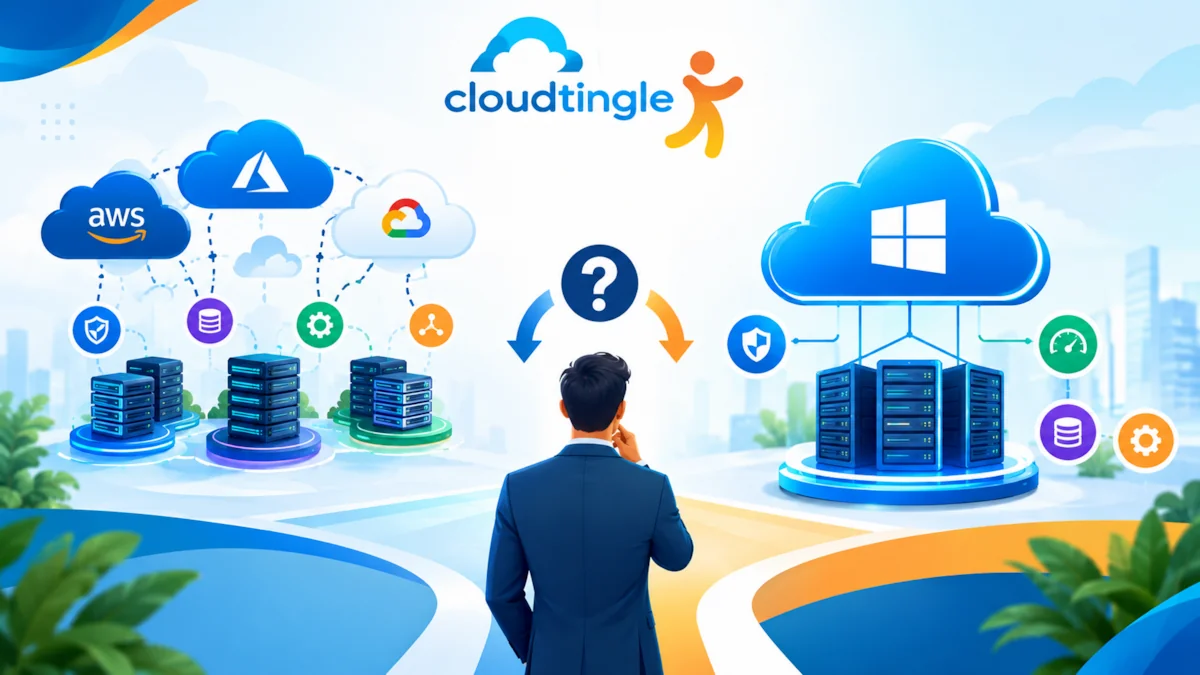
Cloud computing isn’t just an infrastructure alternative anymore, it’s a strategy for modern businesses. As businesses move to the cloud, the question of whether to centralize workloads in a single cloud service provider or spread them out among multiple ones is becoming more important. The solution will vary based on the complexity of operation, budget, workload characteristics, compliance requirements, and long-term growth goals.
There are two approaches which dominate this discussion: Multi-Cloud and Single -Cloud. They each have their own benefits and drawbacks that impact performance, resilience, management and return on investment. Being aware of these differences can help companies to build an economic cloud architecture without creating a brittle environment.
Understanding The Multi-Cloud Strategy
Multi-Cloud is a strategy that leverages services of two or more cloud providers. Rather than having all applications, data, backups, or computing tasks on a single provider, organizations allocate resources based on technical and/or commercial needs.
A business could have a different provider on each of the types of service, for instance, for application hosting, analytics, and backup or disaster recovery. This design could help to develop a more varied digital landscape.
The main drawcard is the flexibility. An organization is not entirely reliant upon the infrastructure, pricing, service availability or technological roadmap of a single provider. They are able to pick specific services from other platforms as well.
But there is orchestration complexity when diversifying. Several environments where they need to work together can make monitoring, security policies, identity management, networking, billing, and compliance more complex.
Advantages Of Multi-Cloud
The most significant advantage of Multi-Cloud architecture is risk spread. In the event of a service disruption, workloads may continue to run if they are hosted on different providers and have been designed with failover in mind.
The other benefit is vendor flexibility. Organizations can also compare computing resources, storage options, database technologies and special services between different providers. When workloads have different technical characteristics this can be beneficial.
Cost optimization is also a crucial factor to take into account. Instead of taking the price of a service provider for granted, companies can review the use of resources and route workloads to the right price. Careful monitoring is essential, though. If there is no governance, a multitude of cloud bills can quickly become a confusing financial maze.
Geographical expansions are another possibility for Multi-Cloud. Companies supporting customers in various areas can choose infrastructure based on the latency, data residency, and availability needs.
Disadvantages Of Multi-Cloud
Operating in Multi-Cloud, flexibility comes with operational costs.
Multiple providers means multiple dashboards, APIs, security, networking and billing systems. Technical knowledge may be required across a larger team and centralized observability and cloud-management tools may be needed for the organization.
Security can also be more complex. Each added environment adds an extra configuration surface requiring the appropriate locking, monitoring, patching, and compliance checks.
Cloud sprawl is also a possibility. Resources can grow without anyone knowing, resulting in unwanted costs from unused instances, over-provisioned storage, redundant services and unmanaged accounts.
So, it isn’t always cheaper on Multi-Cloud. The financial returns are very much related to careful design and ongoing optimization.
Understanding The Single-Cloud Strategy
Single-Cloud is a strategy that focuses cloud workloads on a single provider. It’s a relatively simple model that may be appealing for small companies, startups and organizations with smaller infrastructure teams.
The overall design is more streamlined with fewer management points, less complicated billing, single support, and consistent operations. This simplicity can be beneficial to organisations that are looking for easy deployment.
When considering cloud hosting India, a business might choose a single provider at first because it can make the infrastructure management predictable, streamlining budgeting and administration.
Advantages Of Single Cloud
The key feature of Single-Cloud architecture is simplicity.
IT teams can get to know one ecosystem, instead of several. Such deployment processes, monitoring, security controls, and support processes can become more standardized, as a result.
The administration of finances can be simpler as well. Businesses have a more streamlined and unified perspective of infrastructure costs, rather than having to add up what they’re spending on multiple providers. This will simplify the budgeting and resource tracking process.
Another benefit is integration. Services within a single cloud ecosystem may be built in such a way that they can easily interact with each other without friction.
This simpler option may be more cost effective than developing a complex distributed system just for diversification purposes for smaller workloads.
Disadvantages Of Single Cloud
The main concern is dependence.
If a company is reliant on a single provider, pricing adjustments, the availability of services and policies or technology upgrades can affect a wide range of people. Or transferring big workloads late might cost a lot and be technically challenging.
It’s possible for vendor lock-in to build up over time. Applications can rely solely on proprietary databases, APIs, authentication or other platform-specific technologies.
Resilience is another consideration. Even with a good single-cloud design, it is possible to have availability zones or regional redundancy, and the organization still relies on the provider’s wider ecosystem.
ROI Analysis: Which Strategy Makes Financial Sense?
ROI shouldn’t be based on just the monthly cost of the infrastructure. Operational labour, migration costs, downtime exposure, security management, scalability, performance and application requirements are all important considerations in a meaningful analysis.
When evaluating cloud hosting price, businesses should think about the total cost of ownership (TCO), rather than just the entry-level fee that is advertised.
When workload portability, competitive pricing, geographic distribution or specialized services are all warranted, then Multi-Cloud can be financially valuable. On the other hand, Single-Cloud can deliver better operational economics in more simple workloads and where simplicity is important to the organization.
Therefore, the term cheap cloud hosting needs to be taken for granted. Low initial price doesn’t always mean the lowest long term cost. The total cost can make a big difference in storage growth, bandwidth use, backups, support, management burden and other services provided.
Choosing An Appropriate Strategy
When making a decision, you should start by looking at the business requirements, not the architectural styles.
Multi-Cloud architecture might be a good choice for organizations that have diverse workloads, strict resilience needs, global operations, or significant cloud-management experience. Single-Cloud might be simpler for businesses that have simpler applications, smaller teams, and a preference for centralized administration.
A best practice method is to consider workload requirements, anticipated expansion, regulatory compliance needs, recovery needs, technical skills and overall ownership cost.
Final Thoughts
Multi-Cloud and Single-Cloud are two approaches to infrastructure management. Multi-Cloud is about diversification, flexibility, and provider independence, whereas Single-Cloud is about simplicity, single management, and operational coherence.
Both do not apply to all situations. The stronger strategic decision is made when design of the infrastructure is tailored to the actual workload and measurable financial goals. When looking at performance, resilience, the complexity of management and scaling, and total cost of ownership, businesses can build a cloud strategy that is manageable now and flexible enough for the future.