
Application development requires speed, portability and scalability these days. It’s here that containerization and cloud hosting have emerged as critical elements. Rather than installing an application onto a server and dealing with the intricacies of dependencies, developers can bundle the application, its libraries, configuration, and runtime into a portable container.
Two technologies are often mentioned in this context: Docker and Kubernetes. They are generally referred to collectively, but they address distinct problems. Once you grasp this difference, it becomes much easier to select the proper architecture for an application, ranging from a simple website to an extensive cloud-based application.
What Is Containerization?
Containers are a way to package software to ensure it works the same way in various environments. A container uses the same kernel as the host OS, and maintains separation of its processes and dependencies.
Imagine a container to be an equal shipping crate. The contents are variable, but size and operation are consistent. Likewise, a software application can be deployed from a developer’s laptop to a test server and ultimately to a cloud environment without having to rebuild the entire software application.
This portability becomes more important in the Cloud Hosting environment where the workloads can be shifted from one virtual machine to another, from one availability zone to another, or from one infrastructure provider to another.
What Is Docker?
Docker is an ecosystem and platform for creating, packaging, distributing and running containers. It provides a relatively easy solution for developers to package an application into a container image that can be reproduced.
The typical Docker workflow is:
- Write an application environment Dockerfile file.
- Run the docker build command.
- Save the image in a container registry.
Run and deploy containers anywhere that Docker-enabled infrastructure can be found.
Docker is great at the container level. It is elegant in providing packaging and execution of individual services, which makes it great for development environments, testing, microservices, and smaller deployments.
In the case of a web app, this could be the frontend, the backend API and the background worker. All components are independent and can be developed and deployed separately.
What Are Kubernetes?
Kubernetes is a layer above that. It is a platform that orchestrates services of containers across clusters of machines.
It is fairly easy to run one container. The running of hundreds of containers over several servers is a different matter altogether.
Kubernetes can automate the following things:
- Allocation of containers to different servers.
- Restarting failed workloads
When scaling up or down:
- Performing rolling deployments
- Providing service discovery
- Networking between workloads.
- To ensure the desired application states are maintained.
It is a philosophy based on a declarative approach. Administrators just tell the infrastructure how they want it to behave and Kubernetes will continually strive to keep it that way.
Docker Vs Kubernetes: What Is The Difference?
The easiest way to tell the difference is:
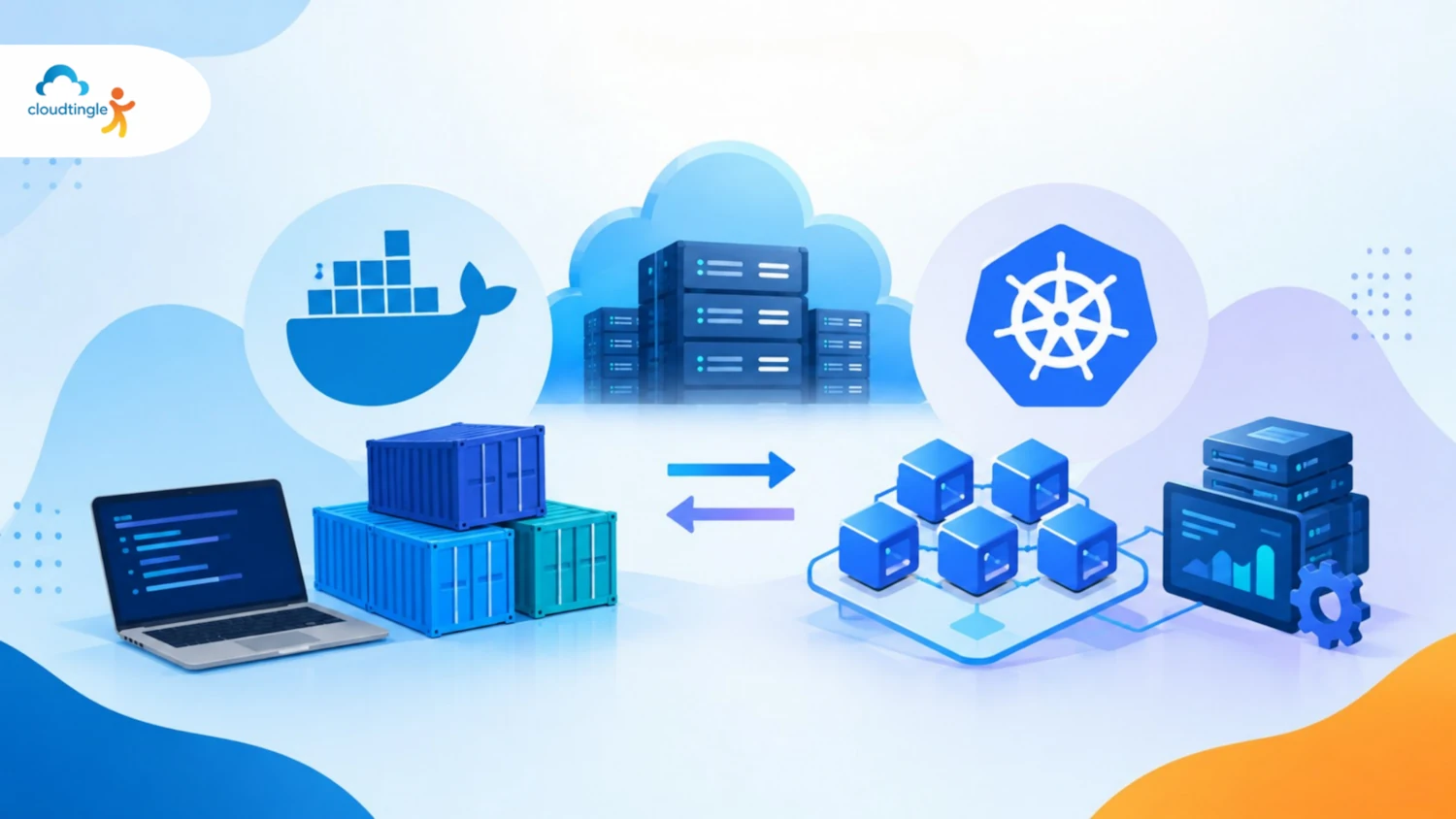
Docker runs and packages containers, Kubernetes orchestrates containers at scale.
There is a distinction, therefore, between them; they are not necessarily competing technologies.
A developer could deploy an application container, such as a Docker container, into a Kubernetes cluster using Docker.A developer can deploy an application container, like a Docker container, into a Kubernetes cluster via Docker. Here, Docker is responsible for packaging, and Kubernetes for the wider context.
Under the orchestration layer of Kubernetes, though, lies a container runtime, and modern Kubernetes environments tend to deploy containerd or CRI-O instead of Docker Engine directly.
Which One Should You Use?
Depending on the complexity of the work load, the right choice will be made.
Docker might offer all the needed tools for a small application with a couple of services. Its relatively simpler workflow can minimize the operational overhead and ease deployments.
The more complex the orchestration that an organization requires the more relevant Kubernetes becomes.The more complex the services, the more complex the scaling, the more of high availability, rolling release, workload scheduling, and nodes or infrastructure spreads, the more relevant Kubernetes becomes.
There’s also a grey area. With some of that administrative headache lessened by managed Kubernetes services provided by cloud vendors, Kubernetes introduces a significant amount of architecture complexity.
Containerization And Cloud Hosting Costs
Whilst using containers can help to better utilize infrastructure, it doesn’t mean hosting is inexpensive. These factors all affect the bill, including resource usage, storage, bandwidth, backups, managed services, and operational needs.
Therefore, it is crucial to consider more than the published monthly server rate when comparing cloud hosting price. While the cost of a low-cost virtual machine might sound good at the moment, the cost of traffic, snapshots, databases, monitoring, managed Kubernetes, and more will add up quickly.
Availability of data-centers in the region, pricing for bandwidth, support, compliance, and currency used for billing can also play a role in the practical economics in case of business that is considering cloud hosting India.
Similarly, budget-friendly cloud hosting might be appealing for prototyping and smaller workloads, but the cheapest price you hear doesn’t always translate to the cheapest total cost of ownership. Limits on resources, technical support, scalability, and reliability must be considered alongside.
The Bottom Line
Docker and Kubernetes aren’t just alternatives, but complementary parts of the containerization puzzle.
The emphasis of Docker is on the creation and run of containers. Kubernetes is about orchestrating containerized workloads over infrastructure.
In simple applications, Docker can be an effective and easy-to-understand deployment model. Kubernetes offers a much more comprehensive operational context for larger, distributed systems that need automated orchestration and resilient scaling.
The true architectural conundrum is not just “Docker or Kubernetes?” It’s how much orchestration the application actually requires. The easiest technology that meets the workload can avoid an unnecessary level of complexity and will allow for future growth.