

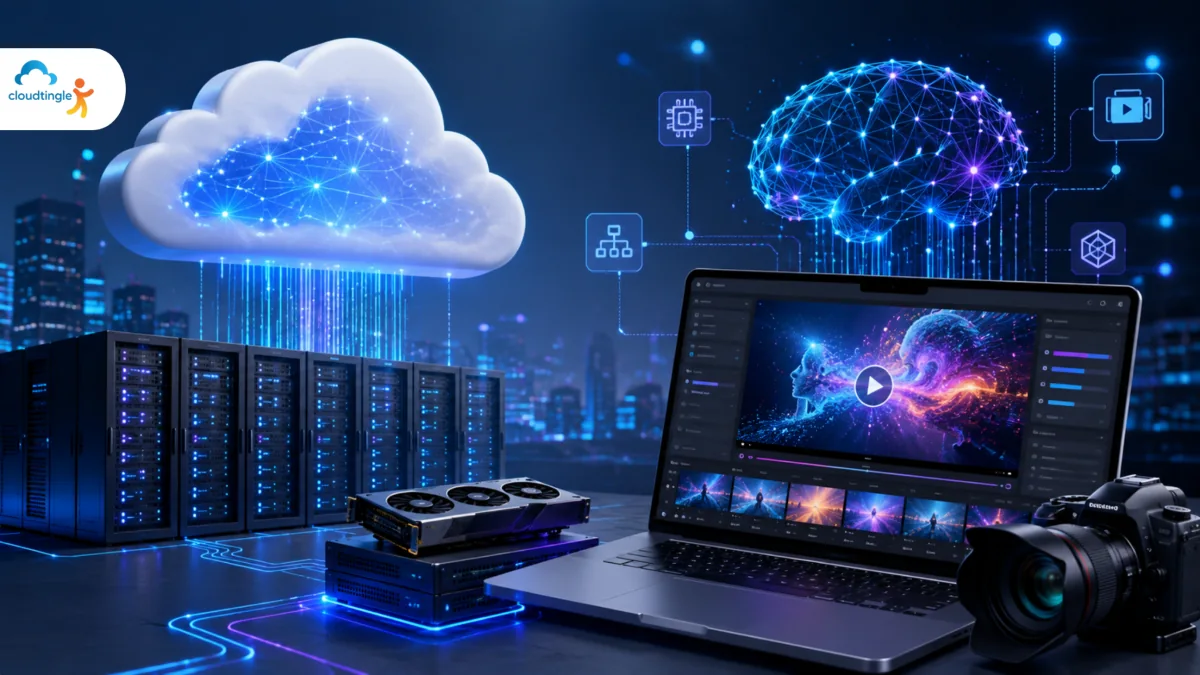
AI has transformed the creation of digital content, including the generation of video, which is now an invaluable asset for businesses, marketers, educators, and the media. AI video generation requires significant computational resources and a robust hosting infrastructure, ranging from video production for promotions to creating training videos or generating content at scale with customization. However, the demands of complex AI workloads for performance, scalability, and flexibility are where modern Cloud Infrastructure comes into play.
Cloud-based infrastructure is designed to provide flexibility and scalability for resource-heavy applications, whereas a traditional hosting environment is limited in terms of resources it can handle. The architecture allows AI models to handle large amounts of data, deliver videos quickly and ensure performance consistency, even under high-load conditions.
Why AI Video Generation Requires Powerful Infrastructure
The generation of video footage using AI entails several different computational stages, such as data preprocessing, model inference, video rendering, image synthesis, and post-processing. There is a huge requirement of CPU, GPU, memory, and storage in each stage.
On-premises systems tend to fall short of these needs due to the constraints on hardware resources. With the expansion of the physical infrastructure, there is a need for extra investment, installation and maintenance.
But with today’s cloud server hosting technology, companies can upgrade their computational resources according to their needs, and there will not be any restriction to this.
Cloud technology ensures that the changing workloads, such as making a couple of videos per day or handling thousands generated by artificial intelligence assets, can be done easily.
The Role Of Cloud Infrastructure In AI Workloads
A good Cloud Infrastructure can offer the computing power to power the training of AI models and perform video generation tasks effectively. Multiple servers are interconnected to distribute the workload among them, thereby providing high availability and preventing any server from becoming a performance bottleneck.
Key advantages include:
- On-demand computing resources
- High-performance processing
- Automatic workload distribution
- Built-in redundancy
- Faster rendering capabilities
- Simplified infrastructure management
This versatility enables developers to concentrate on advancing their AI models rather than dealing with hardware constraints.
Scalability For Growing AI Projects
The biggest benefit of cloud computing is the flexibility of the resources that can be scaled up and down as needed.
Video generation workloads with AI are not always uniform. Process needs can be a major concern during marketing campaigns, product introduction, media production or during seasonal demand peaks.
With cloud web hosting technology, an organization can increase their computing power overnight and it doesn’t require any purchase of additional hardware.
CPU, GPU, memory, storage, and bandwidth can be easily upgraded according to the workloads of the business.
High-Speed Data Processing
Many images, audio files, video assets and machine learning datasets are continually processed by AI applications.
Cloud server India adopts high-speed storage solutions like SSD or NVMe, advanced networking infrastructure, and optimized data centers to speed up file access and processing.
Much faster storage allows for much quicker rendering and more responsiveness of AI applications, allowing creators to produce content in a much more efficient method.
Reliability And Business Continuity
Video generation projects are usually time consuming processes. Unexpected hardware failures can interrupt workflows and cause loss of work.
Cloud environments reduce this risk by transforming the infrastructure into a distributed one.
In the event of the breakdown of one server, the load will be transferred to another server. This redundancy keeps uptime and guarantees continuous process of critical artificial intelligence applications.
Reliability and productivity are key for organizations creating content in large volumes.
Security For AI Data
Proprietary datasets, customer data, and IP are very common in the field of AI development and require robust protection.
Advances in cloud services in India include enterprise-grade security elements like:
- End-to-end encryption
- Identity and access management
- Network firewalls
- DDoS protection
- Continuous monitoring
- Automated backups
- Disaster recovery capabilities
These security measures make sure that the data is kept safe and secure, and also help the organization comply with the standards set by the industry.
Cost Efficiency And Resource Optimization
A major challenge to developing on-premises AI infrastructure is the need for high capital investment in servers, GPUs, networking gear, cooling systems, and maintenance.
Cloud computing offers a more accommodating solution.
Businesses should pay attention to processor power, availability of GPUs, the storage requirements, consumption of bandwidth, managed services, and backup options while assessing the cost of cloud servers in India.
Instead of investing in the equipment that is not being used, organizations can invest in only those resources that are necessary depending on projects.
This type of pay-as-you-go pricing allows using the latest AI infrastructure for start-ups, growing companies, and enterprises.
Choosing The Best Cloud Environment
There are a number of technical factors to consider when choosing the optimal cloud server for AI video generation.
Important factors include:
- Super high performance CPU and GPU options.
- NVIDIA NVMe SSD or NVMe.
- Low-latency networking
- Flexible resource scaling
- Automated backup systems
- Strong security controls
- Reliable uptime guarantees
- Comprehensive technical support
Yet another critical point to consider while selecting a cloud service provider is the geographical location of the data center, particularly when latency begins to become important while working with others or with clients.
Best Practices For AI Video Infrastructure
Here are some best practices to increase the performance of the cloud:
- Minimize computation within AI models.
- Take advantage of distributed storage of massive data sets.
- Continuously track resource use.
- Enforce auto-scaling policies.
- Schedule regular backups.
- Protect workloads using role-based access controls.
- Compress media files as needed.
- Keep software and dependencies up-to-date.
By following these best practices, efficiency and responsiveness of the infrastructure during high workloads are assured.
Future Of AI Video Generation In The Cloud
AI-generated content is continually evolving. Novel developments of generative models, real time rendering and intelligent automation are pushing the computational load on hosting platforms.
The innovations are likely to continue to rely on cloud computing to offer nearly limitless scalability, enhanced hardware acceleration and sophisticated networking options.
Organizations opting for Cloud Infrastructure would have an added edge in producing quality videos faster, operating their business in such a way as to minimize complexity, and adapting themselves to the changing demands of the market.
Conclusion
The creation of AI videos requires a host offering the best performance, scalability, security, and reliability. To address these requirements, Modern Cloud Infrastructure offers flexible computing resources to accommodate changing workloads and reduce the management burden of infrastructure. The choice of the right cloud server, from assessing the best in the cloud, to comparing cloud server cost in India, exploring cloud server hosting solutions, deploying a cloud server India solution, utilizing cloud services in India, to investing in cloud web hosting, all of this sets the stage for efficient AI video production and long-term digital innovation.



One thought on “Cloud Infrastructure For AI Video Generation Workloads”