

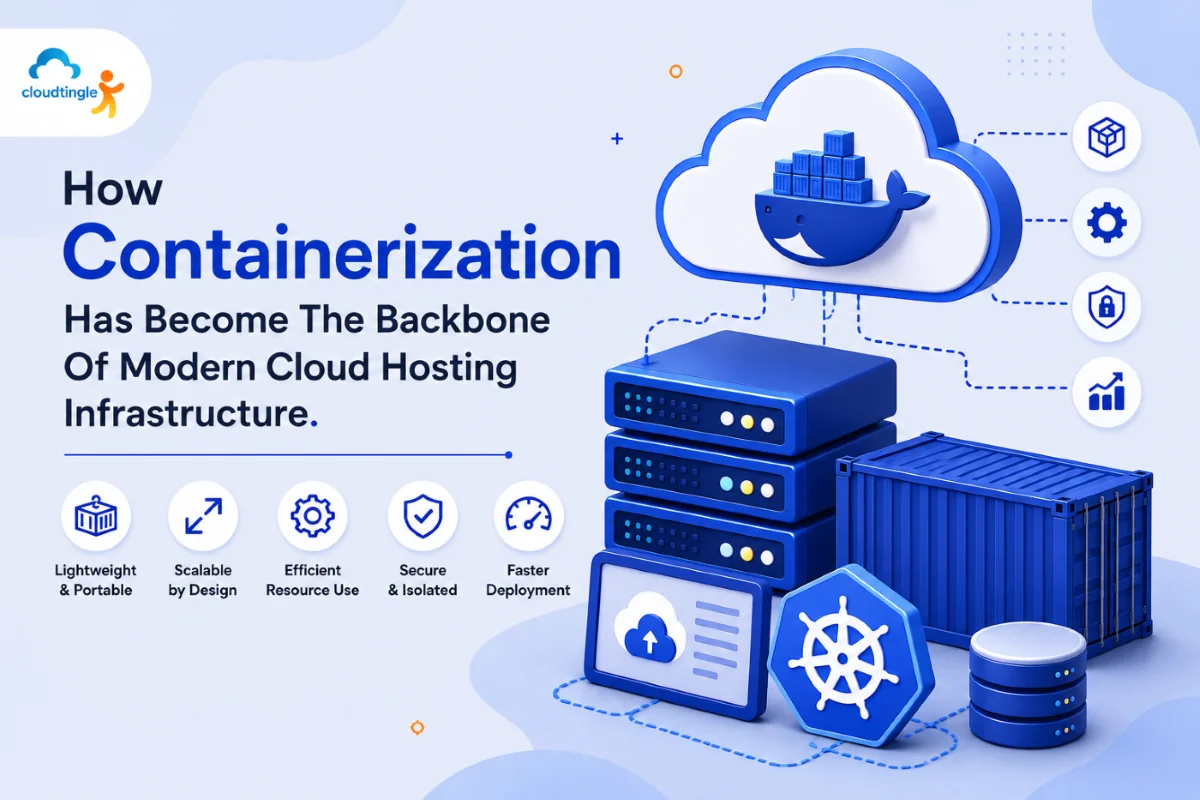
The digital world has changed dramatically in the last 10 years. Companies no longer have the luxury of running simple websites with specific types of traffic and relatively low computational requirements. The modern digital platforms today have to handle real-time analytics, AI-based systems, SaaS environments, streaming, enterprise applications and big data interactions, all of which demand infrastructure that can scale on the fly.
Once thought to be secure, the traditional architecture modes are not coping with these new operating requirements. Business continuity is now a must-have requirement for scalability, deployment time, resource efficiency, and infrastructure portability. In today’s fast paced world, containerization is one of the most transformative technologies of the future of cloud computing.
Containerization In Modern Cloud Hosting
In this article, we will explore how the modern hosting infrastructure came to be.
Traditional hosting systems relied mostly on physical servers and eventually virtual machines. Virtualization was a huge step forward that made hardware use much more efficient, by enabling several operating systems to run on a single server. This was still not an efficient model though.
Virtual machines needed their own operating systems, took up a lot of memory and usually caused problems with the compatibility of development and production environments. The deployment process slowed down and infrastructure was scaled more complexly.
Containerization: The Smarter Hosting Approach
Whereas virtualizing entire operating systems isolate the applications, containers isolate just the applications themselves. An application and its dependencies, libraries, runtime components and configuration are packaged into an environment that is lightweight and can run in a consistent manner on different infrastructures.
This innovation solved a lot of the operational complexities that come with traditional virtualisation. Containers could be deployed quickly, managed easily, and were much more resource-efficient.
This has created an extremely flexible infrastructure ecosystem, designed for modern cloud environments.
Why Containerization Became Essential
Today’s cloud infrastructure requires speeds, continuous deployments, fault tolerance, and automated resource allocation. These operation priorities are a perfect fit for the implementation of containerization technologies like Docker and Kubernetes.
Applications running within containers are incredibly portable between development, test, staging, and production systems and servers. Multiple infrastructures can be addressed by developers so that there will be no need for compatibility issues when developing software only once and then deploying it across multiple infrastructures. In such Cloud Hosting India cases, reliability plays a large role in providing businesses with dependable performance and resilient infrastructures that can accommodate changes in traffic patterns etc.
There are several important benefits to containerization:
- Rapid deployment capabilities
- Improved resource utilization
- Faster infrastructure scaling
- Simplified application management
- Enhanced portability
- Lower operational overhead
- Better deployment consistency
These benefits have made containerization a core element in today’s cloud architecture but not a software development tool.
Let dive into the development of the Microservices Architecture.
The rise of the microservices architecture has increased the container adoption rate a lot. In traditional monolithic applications, all the features were often tightly coupled to a single integrated codebase making it hard to scale.
The Rise of Microservices Architecture
The applications are split up into smaller, independent services each operating for a specific function. Authentication systems, payment gateways, databases, analytics engines and notification services can all work without interference with each other, communicating via APIs.
Containerized/microservices run well within this architecture because each microservice runs within a separate and isolated Running Environment. This allows for better operational flexibility and also reduces the risk of large-scale failures.
Another reason there is such an increase of containered/microservices is that they improve reliability in terms of:
- Infrastructure resilience
- Development flexibility
- Fault isolation
- Scalability precision
- Continuous deployment efficiency
It is hard to imagine running agile operations in a modern cloud ecosystem without container technologies that enable the deployment of microservices.
Reduce Resources And Optimize Infrastructure.
Optimization of infrastructure has emerged as a strategic business issue. Organizations look for places that could offer them the best computational power at the lowest hardware cost.
Containers use much less resources than traditional virtual machines because they share the host operating system kernel, instead of running their own operating system independently. This can significantly increase the workload density, lower processing overhead and decrease memory usage.
This efficiency directly benefits businesses with Cloud Hosting India infrastructure by:
- Lower hosting costs
- Faster application responsiveness
- Better server utilization
- Simplified scalability management
- Reduced infrastructure complexity
- Containerized Cloud Solutions Provide Operational Efficiency
Startups, SaaS, enterprise organizations and growing digital platforms all find Containerized Cloud Solutions Offer Operational Efficiencies Due To Their High Availability Compared To Traditional Cloud Solutions.
Kubernetes & Intelligent Orchestration
As containerized applications increase in number, individual management becomes increasingly more complex due to sheer volume; therefore, innovative orchestration platforms have developed to automate the management of thousands of different workloads. It enables infrastructure to self-manage dynamically even under sudden traffic surges or in the occurrence of infrastructure failures.
Modern cloud providers integrate orchestration technologies, as it enhances:
- Automatic load balancing
- Self-healing infrastructure
- Dynamic resource allocation
- High availability management
- Traffic optimization
- Disaster recovery resilience
Therefore, container orchestration is now essential in enterprise-class cloud-hosting environments.
The Security Advantages Of Containerized Infrastructure.
In today’s digital age, cybersecurity is one of the most critical factors in any hosting system. Containerization enhances security by separating applications into separate runtimes. When one container is compromised, the effect is normally limited to that area.
Many cloud-based systems are also able to utilize containerization along with:
- Vulnerability scanning
- Runtime threat detection
- Access control frameworks
- Encrypted communication layers
- Continuous monitoring systems
- Automated security updates
They offer a better security profile and make it easier to protect critical infrastructure and sensitive information about customers.
Faster & Smarter Code Deployment
As part of its commitment to agile innovation, Kubernetes automates container deployment, scaling, networking, monitoring, & recovery using native cloud infrastructure.
Pre-deployment testing of applications under similar conditions for developers.
This consistency improves:
- Software reliability
- Deployment speed
- Development productivity
- Infrastructure portability
Speedier infrastructure deployment and its adaptability provide considerable strategic advantages for enterprises that operate in competitive markets.
Conclusion
As containerization continues to emerge as a game-changing technology in the cloud hosting realm, it’s continuing to prove its unmatched capabilities with respect to efficiency, scale of operations, portability, and distribution of applications within the cloud environment. Container technology has a strong focus on performance, is easy to work with, reduces complexity in infrastructure while optimizing resource utilization.
Modern containerized environments have become the basis of cloud computing technologies from microservices deployment and management using automated orchestration to fast scaling up.
With the rapid pace of the digital transformation in the world, cloud-based containerization will remain a key player in the future of Cloud Hosting India solutions and enterprise hosting solutions across the globe.



3 thoughts on “How Containerization Has Become The Backbone Of Modern Cloud Hosting Infrastructure.”